
Current state of Yoga
Yoga does not seem to be as popular as it was. (Pilates and Hot yoga seem to be all the rage currently.) At least that’s what those of us who have been at this for over 20 years are noticing. Somewhere between fallen gurus and rules that are not fit for normal bodies; yoga has fallen out of favor.
Add to this many yoga poses are more scrutinized than ever before due to many yoga teachers having hip or knee replacements. Yoga is supposed to protect us from this, right?? And perhaps those teachers would have had to have a joint replacement whether they did yoga or not? Hmm possible for sure, still the extremity of some of the poses would lead me to believe it was more likely too much yoga asana.
Extreme poses need to go —leg behind the head, kapotasana and other deep backbends are more problematic than helpful. While it’s so easy to get caught up in the fun of some of these poses, and maybe we can for a short period of time, in general they need to go and we as teachers need to stop glorifying them. “Binding is not all its cracked up to be”! When we promote these crazy poses we are only catering to a very small percentage of the population who’s bodies may be able to go there.
In reality, we need to cater to the more than 80% of the population that is not hyper-mobile. And hyper mobile is not good anyway! Too much flexibility around a joint leaves it vulnerable to injury. It’s a balance between strength and mobility, a healthy range of motion. I learned this myself; I came into the practice naturally tight. The flexibility I gained through years of dedicated practice did not come from my genes.
As I developed overuse injuries and started backing off on the intensity of my practice, I noticed my lower back tightened up a bit —I don’t go all the way down in forward bends anymore. And guess what, I have no back pain. Being able to rest my sternum on my Femur (thigh bone) = low back pain. Not being able to = no pain. Lesson learned. Don’t push, don’t try to achieve a certain pose or a certain way to look in a pose. Enjoy the movement of yoga and breathe.
Yoga is about learning correct breathing, mobility, freedom of movement in your body, nervous system balancing, circulation, releasing tension, and counterbalancing everyday life. Most important is nervous system balance. Pushing your body in a pose pulls your nervous system out of balance. Its counter-productive.
Nervous system balance leads to the “text book” reasoning behind yoga; mind control. Not stopping the thoughts, you won’t. Realizing your thoughts for what they mostly are, not true. “Worrying must work, none of my worries seem to happen.” Being able to direct your thoughts at will to what you want to think on is a more glorious reason for yoga.
If we can get this message out, maybe people would come back.
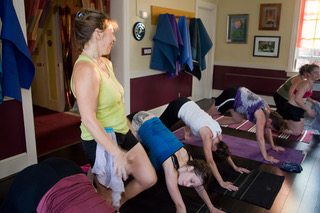 Yoga poses that are under fire currently:
Important to note; poses don’t have alignment, people do. If you are in a yoga class and someone is rattling off a laundry list of alignment cues, tune them out. Most set cues for certain poses are not valid for many people.
- Trikonasana and Virabhadrasana II (Triangle and Warrior II) – Cuing to “square your hips” is no longer recommended. Remember the old days of saying stack the hip bones in triangle pose? Don’t. Not natural for the hips. Instead let the top hip in triangle pose have some freedom of placement, and the same with the back hip in warrior II.
- Pigeon pose – This pose has been under fire for a few years now. As long as you don’t take it too deep or extreme it can be a helpful pose to release tension around the back upper hip. Though there are other poses that effectively do this without the strain of being too intense. If pigeon pose feels good to you, like its a release, its probably ok. If not, other poses that can do the same for the hips are supine figure 4 stretch, seated cradling the leg to your chest, and also lying down while cradling the leg if your flexibility allows. Also the 90/90 pose with a forward bend would stretch through the same area. You can also try gentler versions of pigeon by standing and placing your leg in pigeon position on a chair or counter.
- Anterior and Posterior Pelvic tilts – Forever it has been believed it is safer for your lower back to do a posterior pelvic tilts in backbends. Now that is being challenged, for some it may be better to do an anterior tilt. An anterior tilt in a backbends follows the movement of the backbends vs. countering it. I think it comes down to your natural spinal alignment. If you tend to have a deeper arch in your lower back curve, it seems honoring that in a backbend is helpful. If it feels better in backbends to do a posterior tilt, then that is your way of back bending —not necessarily everyone else’s.
Next time you find yourself in a backbend; try out each way and see which your body prefers. Honestly both ways feel ok to my body.
- The most crazy change I have seen — knees over toes! Meaning bending your knees beyond your toes. WHAT??! Personal trainers, fitness instructors, and yoga teachers alike have preached for years to keep your knees behind your toes. Turns out its not necessary, letting your knee go past your toes in squats and lunges on contraire is essential. The knee is meant to flex beyond your toes; it restores lost range of motion, builds strength in the knee and has studies showing it reduces knee pain.
Personally I like it. Everyday life requires it! Walking up stairs, squatting down to to the floor requires your knees to flex beyond your toes while it is weight bearing.
It builds resilience in your knees, ankles, and hips. They need to load and lengthen to stay healthy. Full body controlled loading in these ranges improves balance, coordination, and the brain-body connection. Using your joints to their full range of motion can stimulate the production of synovial fluid which keeps the joint lubricated and healthy. It supports longevity, the ability to squat deeply and stand up with ease is one of the most important indicators of mobility and independence as we age.
If this range of movement in your knee is new to you, or painful, don’t push through it. Instead slowly increase your range of motion over time. You can’t protect your knees by avoiding movement; your protect your knees by strengthening them.
A 2021 study in the British Journal of Sports Medicine looked at two methods of healing patellar tendinitis. One method used traditional training pushing through pain. The second method used a progressive tendon loading approach (such as a full squat) with slower, more mindful movements that gradually increased in challenge without pushing into any pain.
The latter method led to better knee function and reduced pain, with stronger long term outcomes as well.
Progressive tending loading study:https://pubmed.ncbi.nlm.nih.gov/33219115/It is bio-mechanically safe to allow your knees to move into deep flexion even when they are loaded or weight bearing — it strengthens your quads, glutes, and can alleviate pressure in the knee joints. It does require sufficient ankle mobility, which you might have lost if you have not been letting your knees go past your toes. You may also need to improve your quadriceps flexibility if you feel tight in a full squat
Some re-training may be required to be able to go further into this range of motion, if you have difficulty keeping your heel down when you go deeper into a squat or a lunge you need to stretch your calves to improve your ankle mobility. The ankle needs to be able to move into dorsiflexion. Downward dog helps with this as does any standard calf stretch.
- On another note; I have been favoring backbends over forward bends as we mature —I turned 60 this year and some of you in my classes passed that milestone as well —and some of you a decade or more ago.
More backbends post menopause is mostly because of spinal health, we’ve all seen older people with postural kyphosis or rounding of the spine. When rounding of the spine is from poor habits, its fixable. Structural kyphosis from osteoporosis or vertebral fractures is more challenging to correct.
The best movements to prevent kyphosis are prone backbends such as shalabasana (locust pose), cobra, dhanurasana (bow pose), and anahatasana (heart to the floor pose) which the latter is done more quadraped than prone. These spinal extension based movements strengthen the back muscles and help to reduce the risk of vertebral fractures.
What is important about alignment? Feet. Breathing.
The feet in standing poses is important, spreading the toes, slightly engage the toes, awareness of the outer edge of your foot and if you are rolling your ankles inward (over pronation). Start with your foot awareness then work upward finding your comfortable alignment.
A deeper perspective on yoga postures
In the past, especially in the “new” way ashtanga was being taught in Mysore there is a lot of emphasis on accomplishing a posture which required people to push to their edge and past it, go deeper in a pose than your body naturally wanted to go, there was a lot of “perfecting” of poses, and just pushing your limits in general.
While challenging yourself in an effort (not in pushing your body beyond where it falls naturally) may be helpful at times; tying spiritual progress to “going further” into a pose is not accurate. From what I have observed, this approach has not really worked so well at all; just look around at what the yoga industry has become.
Patanjali, in his Yoga Sutras, has little to say about asana. He says; what matters is you are calm, and your mind is filled with ease when you practice. Effort is there, however it should be steady, measured, and peaceful. By lessening the natural tendency toward restlessness (not being happy with where your body is in a pose) or trying to achieve a posture, your mind will move toward expanded awareness while practicing. When you are mindful to practice in this way, your perceptions shift— the ups and downs of life do not throw you off your center. All postures, whatever they look like, are meant to be practiced in this way and to have this effect; and interestingly, there is not a single word about stretching or attaining a shape in this description (YS 2.46–48).
Acceptance is a more important part of a yoga practice, such as accepting where your body lands in a pose. The last 3 niyamas (and the core of kriya yoga) from the yoga sutras (YS 2.1) is discipline, self study, and acceptance. Reminds me of the serenity prayer:
“Grant me the serenity to accept the things I cannot change (self study), courage to change the things I can (discipline), and wisdom to know the difference (acceptance). These are higher aims from our yoga.
Critical thinking is a part of a yoga practice, inquiry -not pursuit of the prefect pose. Don’t be afraid to challenge a teacher or the proposed alignment of a pose.
It’s like we have to learn being comfortable with being comfortable in our yoga practices—we’ve all learned how to be comfortable with being uncomfortable (thank you ashtanga). Its OK for your yoga practice to be comfortable!
On the last 3 niyamas, which are also the basis of kriya yoga:
- Tapas means discipline and refers to a consistent practice. Some also reference tapas as increasing heat in the body for detoxification
- Svadhyaya means self study — of mind and body interoception including meditation and realizing how your thoughts effect your physiology, and how your thoughts and words effect those around you
- Ishvara pranidhana — most translate this as surrender to self, or universe, or higher belief. But pranidhana does not mean surrender it means “a perfect inner alignment with a transcendent consciousness that is beyond time and space”. What happens from that alignment? The inward movement of awareness, which removes the six poisonous emotions known as kleshas (more coming on that), and reconnects to knowledge of the Self.
I like to express Ishvara Pranidhana simply as don’t think your way is right for everyone, or your opinion is best for all. Or more simply put awareness.
Yoga and the Monkey Mind
Thoughts don’t matter!
Thoughts are just thoughts, mental sounds…you’ll never succeed in stopping thoughts. No one does: not the Buddha, not the Dalai Lama, not the Zen or yoga teacher who looks so peaceful. What they may have succeeded in doing is noticing thoughts don’t matter.
Long time meditators and monks with over 20 years of meditation practices were studied to see how long they could hold one thought … the longest was 12 seconds.
Our mind thinks thoughts just like our heart beats. We don’t try to stop our heart from beating, so let’s not try to stop our mind from thinking. Just know what your thoughts are good for and what they are not good at.
“Don’t believe everything you think” was a sign that hung in my yoga studio for years. I think “pun intended “ this where we go wrong. We believe our thoughts.
Where thoughts do matter is when we are dwelling on the negative or what we don’t want in our life. This can change our physiology for the worse and maybe even manifest what we don’t want. The tendency of the mind is to dwell on the negative, on average we have 3-5 negative thoughts : 1 positive thought; this we can change by noticing it.
When you catch yourself ruminating, step out of your mind for a moment and watch it, laugh at it, and don’t always believe it. When you catch yourself getting caught up in some story the mind is fabricating, turn your mind onto what is happening in the present; what are you feeling? Get into your body, your body is always present. The mind is not the best at discerning Truth. The body can FEEL Truth.
When we get caught in our stories, the seduction of the monkey so to speak, we leave our bodies. Our problems are stories, our situations can be met with more clarity, solutions and guidance when we try to feel into what the body is holding.
The next time you are wondering which direction to go or are worrying about something; sit, place your awareness in your body, breathe slowly for a minute or two, what do you feel? Where do you feel it? Search your body for any areas of tension or unease. I like to start with placing my awareness in my abdomen just below my navel. I sit and breathe for a few moments tuning in. Then search my body for areas where I may feel a little tension. Where you feel the tension may give you some answers. It may be something you are holding in your body or it may connected to a chakra, if so the area of life that resonates with that chakra could also be a clue. This can help you feel in to what you need in the moment.
Practice this most days for a few minutes; you need to practice it during times you don’t need it so you can recall it easier when you do. After some time you’ll be able to recognize what your body is holding or trying to tell you.
Traditionally a meditation practice gives your mind something to focus on to improve your concentration skills; it could be a sound like om, a visualization, a flame, your breath, the feel of your breath in your nostrils, anything internal. Each time you catch yourself getting wrapped up in a mind story, you direct it back to your focal point. The work of doing this has great benefit to brain health, it rewires neural pathways that give you better emotional control. The more often you do it, the sooner you catch it.
One of my favorite meditation practices during challenges is to turn negative thoughts into positive thoughts. When my mind starts to spin on it, I dream the perfect scenario (or at least the perfect scenario at this point); take the negative and turn it positive in my mind.
There is a good side to the monkey mind.
The good business of the monkey mind is to discern, judge, elaborate, define, interpret, analyze, and learn. We want to use these aspects of our thinking mind.
I came across this interesting view on our thoughts; the neurological activity of cognition is the result of metabolizing solar energy from the food we eat. Literally, our thoughts are sunlight transformed by plants into inner luminosity. Viewing my thoughts as inner luminosity changes my experience of thinking, making it easier to keep my thoughts illuminating.
Remember to not mistake the method for the goal. Meditation is not about becoming a good meditator, or sitting for long hours —it is about realizing the monkey mind and not letting it spin you off. You are good at meditation if you can catch this process off your mat while you are in the world.
Awareness is the ability to read your own mind, and correct it where necessary.
After all this is what yoga is supposed to be, working with the thinking mind and keeping your thoughts in perspective. Though most people seek yoga for exercise today —and that’s awesome. It’s a superior form of exercise because you are working with your nervous system while exercising. This will reduce the unwanted side effects of exercise such as a stress from a cortisol response to the exercise and the oxidative stress caused by exercise. But lets also keep some yoga in our yoga, even if it is for exercise.
If the thought is not loving or useful, don’t think on it.
Instead of being the mental chatterer. Observe the mental chatterer chattering. Bobbi Misiti
Yoga on Emos
Emotions do not exist only in the mind — they are not just mental events. They are lived through the body; in other words, they are embodied. Emotions are physiological; anything we feel is processed through the body. Both fear and love show up as a quickened heart rate, increased body temperature, and a sense of heightened awareness. It is how we interpret those body sensations that flavors our emotions and which hormones get released. Fear makes someone breathe differently (mouth breathing vs. nose breathing), move differently, and perceive differently than love does — and each emotion has a different effect on which hormones get secreted and how we interpret those hormonal feelings. I like to think of this as a mind-body symphony.
We cannot suppress emotions simply by refusing to acknowledge them. And we don’t want to. We cannot flip a switch in the brain and stop feeling what we are feeling. We can, however, influence them through physical actions such as altering our breathing, posture, movement, muscle tone, facial expressions, and even our relationship to gravity.
Feelings are the cognitive interpretations of emotions. They are colored by past experiences, hopes, desires, wishes, and positive and negative associations — and so they are often not a clear reflection of the emotion itself.
A potential problem arises when we think the feelings, sensations, and emotions associated with our chemical responses to be fixed and real, when in fact they are not a fixed reality. If we believe every feeling to be true, then we end up living according to the thoughts they generate in our minds.
An emotion or feeling is temporary, and it primarily communicates or signals something, though sometimes we have to spend time figuring out what that signal is about, which isn’t always easy. Whatever we are feeling is a changing state. When a feeling is strong, we become so immersed in it that we believe it completely. Yoga has a term for this: *avidya*, or ignorance.
Yoga can influence which hormonal chemicals get released into our bloodstream. These chemicals greatly influence our moods; they are a key ingredient in creating clarity and positivity.
We use chemicals all day long, we just don’t call them that. We call them food, drinks, people, and situations. Every interaction we have, whether with food and herbs or people and pets, creates chemical reactions in us in the form of hormones, neurotransmitters, neuropeptides, and neuromodulators. We are a soup of chemicals, cells, molecules… and an unknown force that organizes it all in our bodies. Better living through chemistry?
**Hormones** are chemical messengers that travel through the bloodstream and attach to cellular receptors in organs and tissues, stimulating a response. Hormones are secreted slowly from our endocrine glands and take a little time to reach their target. Examples are insulin, oxytocin, and cortisol.
**Neurotransmitters** are chemical messengers that pass quickly across synapses from one neuron to another, instantly influencing the receiving neuron to be either calm or excited. Classic examples: glutamate, GABA, acetylcholine.
**Neuromodulators** are chemicals that adjust or “tune” the activity of neural circuits over a broader area and longer timescale (seconds to minutes or longer), often diffusing beyond the synapse rather than acting at just one precise point. Instead of directly causing a fast excite/inhibit signal, they change how responsive neurons are to other signals — like adjusting the volume or sensitivity of an entire circuit. Examples: dopamine, serotonin, norepinephrine, and peptides, acetylcholine (some neurotransmitters can also act as neuromodulators).
Our nervous system and endocrine system work together to produce a feeling.
Yoga practices directly impact our chemical makeup. There is abundant data showing that yoga practices increase GABA, serotonin, dopamine, melatonin, and acetylcholine, while decreasing epinephrine and cortisol, stress hormones.
Neurotransmitters in the lungs directly influence emotional regulation through their interaction with the cardio-respiratory-cortical-limbic network. GABA, dopamine, serotonin, and acetylcholine are all found in lung tissue.
Lung-based neurotransmitters generate bioelectric rhythms that entrain or synchronize heart and brain activity, shaping our emotional experience. Dysfunctional breathing — shallow, rapid breathing — reduces inhibitory, calming neurotransmitters like GABA, exacerbating anxiety, while slow breathing enhances their release.
The yogis knew this. Somehow, they were able to tap into these physiological changes happening in the body.
Emotions are like raw data — pure sensation based on the hormones and neurotransmitters the body releases. Feelings are the stories we tell ourselves about that data. To interpret them clearly, we need to be present and have a clear perspective. If we begin to ruminate, worry, overthink, and project, then our mind interprets the data with a negative spin.
The mind and body are connected, and our mental processes are as physical as they are subtle. Thoughts are subtle, physical, electric, and physiological, all at the same time. For example, anxious thoughts produce adrenaline; loving thoughts produce oxytocin.
Thoughts leave a residue in the brain, known as plaque, which is cleared each night when we sleep. This is one reason why an aim of yoga is to gain control over our thoughts.
Yoga is the mastery of the fluctuations in the field of consciousness: *”Yogas chittavritti nirodhah”* — Patanjali, Yoga Sutras 1.2
Yoga gives us tools to better translate our emotions into feelings. The true aim of yoga is better mind control; if we are not able to do that, yoga isn’t going to work for us.
Yoga is said to be a remedy for calming the mind: *”Manah prashamana upaya yoga ityabhidhiyate”* — Yoga Vasishtha 3.9.32
Yoga is equilibrium of mind: *”Samatvam yoga ucyate”* — Bhagavad Gita 2.48
Fluctuations of the mind impact our emotions, which in turn impact our feelings. Yoga postures, slow breathing practices, meditation, and relaxation all help us calm down and change the signals coming from our endocrine glands — that is, which hormones and neurotransmitters get released into our bloodstream.
Transcendence, enlightenment, and liberated states are said to be beyond chemical messengers.
An important component of yoga is inner contemplation; this is what sets yoga apart from mere exercise. Inner contemplation develops greater inner awareness, which gives us better discernment over our feelings. Yoga is also about learning how to navigate our emotions and feelings.
Western philosophies tend to categorize emotions as untrustworthy and irrational. Eastern philosophies look at emotions as our way in — our way to work on ourselves. First, we have to recognize and acknowledge when we are feeling challenging emotions.
The Rig Veda speaks of six poisonous emotions (*kleshas*) that can develop if we practice without awareness and intention. They are:
- Desire (*kama*)
- Anger (*krodha*)
- Greed (*lobha*)
- Delusion (*moha*)
- Arrogance (*mada*)
- Jealousy (*matsarya*)
If we follow the yoga philosophies, they give us tools and strategies for dealing with negative feelings so that we can choose our thoughts and, hopefully, shift our feelings to leave behind traces of kindness instead.
I want to point out, we are not trying to stop an emotion or feeling. We need to feel the emotion so our body can detox the hormone, otherwise we will store it somewhere in our tissues.
Remember the work of Dr. Candace Pert, who proved the science behind “The Issues are in your Tissues”. ALL THOUGHTS CREATE A NEUROPEPTIDE CHEMICAL that is released into our body. These neuropeptides are neuromodulators that act on more receptors than just a neurotransmitter. They also attach to receptors in our hormonal glands such as the thyroid, hypothalamus, pituitary gland and others sites on our body as well, relaying or blocking information sent to and from the cells.
These neuropeptides are the molecules of emotion that can become stuck in the body and accumulate leading to pain, discomfort, or even disease.
Express it consciously and detox it! Emotions can last seconds, stored emotions can last 20 years (or more).
The tools and strategies yoga recommends are to help us shift the emotion to a more pleasant feeling, not block it or ignore it. Yoga tools and strategies:
Yoga Tools for creating the feel good chemistry: Mudras
Mudras are explained in yoga science as providing a means to access and influence unconscious patterns, reflexes, and primal instinctive habits people fall into.
These patterns originate in the primal parts of our brain, our amygdala and hippocampus located close to the brain stem, this is the area of our brain that takes over when we feel threatened, it’s our survival mode. It seems easy for adults to subconsciously shift our brain power from our prefrontal cortex where we are more conscious, make better decisions and think clearer to our amygdala and consequent stressful thoughts.
Mudras are mostly recognized as hand postures and gestures designed to snap the practitioner out of instinctive habits into more conscious behaviors. Mudras are also attitudes. They are a combination of physical and subtle movements meant to alter our mood, attitude, and perception. The root word mud as meaning delight or pleasure, and dru being a derivative of dravay which means to draw forth. So mudra means to draw forth delight and pleasure. That’s a nice thought 🙂 Most likely it is referring to the release of dopamine and serotonin, our feel good and rewarded hormones.
So we use mudras to influence which hormones we are releasing into our blood stream.
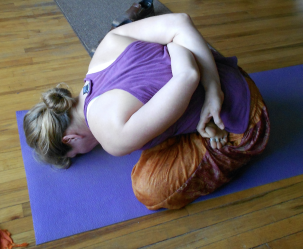 A mudra may involve the whole body using asana, breathing and pranayama, bandhas, and visualizations, or it may just be a simple hand position such as jnana mudra (touching thumb and forefinger together), and anjali mudra (praying hands). Bandhas used to be known as a type of mudra, Mula, uddiyana, and Jalandhara bandhas used to be mudras until their practices become popular, then for some reason they got classified as bandhas instead of mudras. Our three closing lotus flowers are mudras, Janu Sirsasana A makes a mudra.
Mudras are one of the more subtle practices of yoga and are introduced after some time and proficiency is attained with the practices of asana, pranayama, and bandha. They are more common in kundalini and kriya yoga practices. Mudras are touted as helping ones kundalini to escape and rise; in other words shift energy flow in the body and the brain away from primal habits to more conscious behaviors.
Mudras help to engage the cerebral cortex of our brain shifting our brain power to the higher more productive areas of our brain. The head and hand mudras effect the interpretations the nervous system is sending to the brain, this calms the nervous system, brings our awareness from the outside to the inside where we can better look at how our thoughts are shaping our perspective and reality.
Yoga Strategies for dealing with the mind and the chemistry it creates
Part of our work with our yoga practice is to be more aware of what is flitting through your mind all day long as we do our everyday activities of daily living. Can you change your thoughts toward spiritual and emotional growth and not worry and rumination? Here are some strategies yoga offers to assist:
OM
When all else fails chant OM! AAAH OOOOHH MMMMMMM The full three syllabic vibrations feeling them from your gut to your brain. OM is believed to mimic the collective sound of the universe. Chanting OM can move us toward the delta brain waves of restoration. Chanting induces the relaxation response. Chanting OM deactivates the amygdala, slowing the mind to be at peace.
Some other suggestions are from the Yoga Sutras of Patanjali on how to manage emotions and feelings:
- Breathing practices and Breath awareness first; erratic, shallow, mouth breathing disrupts our nervous system and our brain negatively. Train yourself to be a slow nasal breather all day long. This is why we do breathing practices, we are training our body to breathe in the manner we are practicing when we are not thinking about our breath.
- Pranayama breathing techniques that include breath holding raise carbon dioxide in the body which has a calming effect on our nervous system, resetting the nervous system.
- Side note; Breath holding intermittently increasing CO2 in the blood enhanceing the brain’s waste clearance system flushing toxic proteins linked to parkinson’s and Alzheimer’s by making the glymphatic vessels in the brain pulse or dilate and contract, pumping cerebral spinal fluid and toxins out of the brain when we sleep. Holding your breath and then breathing slowly mimics this in an awakened state.
https://www.sciencealert.com/carbon-dioxide-pulses-clears-toxins-from-parkinsons-brains-in-recent-study
- Sensation awareness — what are you bringing into your body through your senses? Scrutinize what you bring in through your senses as much as what you bring in through your mouth. See with your eyes what is pleasant, hear with your ears what is auspicious — don’t watch stressful movies or doom scroll, try to fill your senses with beauty.
- Inner luminosity, feel an inner luminosity or light radiating from your inner being. See it creating a aura of beautiful sunlight around you. This is a nice meditation.
- Stable mind meditation practices, being able to pull away from bad thoughts and switch to the good thoughts at will. Practice will allow you to do this easier and easier.
- By way of the heart is one of the best ways, meditating on the heart. A tool to take control of your thoughts is to imagine breathing through your heart center. Try it! It makes you feel lighter.
- Contemplating the stream of the mind (critical thinking). Why are you thinking like that? What past experiences have led you to the thoughts you are having? And then re-evaluating. Is this still the case here and now? Or is it just a silly thought you can laugh at?
- Contemplating what your mind would be like if you had no desires — contemplate that you have everything you want in life, what would it look like?
- And lastly by contemplating on anything higher minded whatsoever one likes
Yoga also gives us tools on how to navigate our feelings if they are influenced by another person’s behavior. I love this quote:
“The best thing for a human nervous system is another human, and the worst thing for a human nervous system is another human.”
The 4 attitudes to have with people (YS 1:33):
- Friendliness to the happy
- Compassion to the sorrowful
- Sympathetic joy towards the virtuous. Be happy for someone accomplishments as if they were your own.
- Equanimity towards the un-virtuous — in further words don’t let someone else’s wrong doing pull you off your center of well being. Don’t dwell on it, don’t waste energy talking about it.
You have many tools when you’re having a hard time getting a grip on your emotions, nature offers us tools as well in the form of scents and aromatherapy.
- Essential oils can increase serotonin while inhibiting cortisol
- Lemon lowers the neurotransmitters adrenaline and noradrenaline (aka epinephrine and norepinephrine) while it increases dopamine and serotonin
- Lavender helps GABA reach GABA receptors relaxing the stress response and making us feel good. The scent of lavender alone reduces pulse, blood pressure, and pain.
- Clary sage increases dopamine and can be a helpful anti-depressant.
- Black pepper actually increased adrenaline concentration (it is activating) while rose essential oil decreased adrenaline levels.
- Sweet orange demonstrates stress relieving activity by decreasing cortisol in saliva samples.
Sacred scents like frankincense and sandalwood help calm the mind and settle our thoughts; citruses uplift the mood; flowers give us self-confidence, and some, like jasmine, are aphrodisiacs, making it easier for us to feel love. Pines, firs, and juniper berry all clear the air, clear our thoughts, and clear our lungs, making it easier to breathe deeply. Flowers, in particular, calm feelings of anger and frustration.
Taking a walk outside can do all the above.
What kind of chemistry are you creating? In life, exercise, and yoga practices you get to choose what chemistry you are creating in your body. You can create the joy chemicals; serotonin and other endorphins, by breathing deep and enjoying your practice. Or you can create adrenaline by pushing too hard or being unhappy with your body in a practice.
The yoga high or runners high is a dopamine release. Exercise that is a little vigorous but you can rise to the occasion for it will create the “high”. If you are cross-fitting til you puke or pushing (or dragging) yourself through an ashtanga third series practice, you’re stressing yourself. You’ll be happy when the session ends because its over, but you won’t get the feel good dopamine hit. The movement needs to be enjoyable and attainable, as Patanjali states “Effort is there, however it should be steady, measured, and peaceful.” Practicing or exercising in this way also strengthens the calming side of your nervous system giving you better nervous system regulation all day long.
If you feel pain or tightness or tension in a posture, don’t push through it. Relax and breathe it in, invite it. This tension is a stored memory. Welcome these discoveries of tightness with a mothers nurturing compassion. There is a part of you that has witnessed all these little hurts and sufferings since you were a child. Allow them to release, use your breath as a healing balm relaxing the tensions that are trapped in the tightness so those feelings can release your body and mind from their bondage and negative thoughts.
When your practice makes you feel good you WANT to practice. Practicing in a way that makes you feel good creates positive thoughts and feelings. Positive thoughts attract positivity in your life. Pushing in your practice and creating adrenaline is a fear hormone, fear comes with negative thoughts, negative thoughts attract negativity.
Yoga practices are beyond just asana and designed to affect three major pathways in the body and mind:
#1 Autonomic balance – The nervous system, resetting your autonomic balance to being parasympathetic dominant where healing and regeneration can happen.
#2 Brain function – Shifting brain function from the amygdala to the prefrontal cortex.
#3 Endocrine balance – Ways to get our body to release dopamine and serotonin instead of the stress hormones of adrenaline and cortisol.
Yoga is a tool box for this, we have been doing this long before we knew what we were even doing with all this yoga:
- Breathing and Asana are about autonomic balance
- Meditation and pranayama create the awareness for the brain to shift from the amygdala to the prefrontal cortex
- Combining breathing, meditation and posture create Mudras which help to make the hormonal shift in our body from the stress hormones to the feel good hormones.
A Meditation to relax your brain and feel the love:
- Sit tall, shoulders relaxed.
- Click your tongue a couple times, trying to keep your tongue to the roof of your mouth as long as you can before it clicks down. This stretches the root of the tongue, and releases the hypoglassal nerve (12th cranial nerve, controls movement of tongue) that runs from your tongue into the vagus nerve. This signals your body that you are in a safe space, and you can relax
- Now relax your tongue on the roof of your mouth. Slow your breath rate down, with slightly longer exhales. Any comfortable slower pace with extended exhales is good.
- Picture a large empty space behind your eyes. Feel how this allows your brain, your eyes, your cheeks to all relax.
- Visualize your physical heart, heart space or heart chakra. Imagine you are breathing right through your heart space. Inhaling and exhaling right through your heart.
- Switch your attention to your inhale; see yourself inhaling love, inhale it right into your heart. With each inhale see the love pouring in. Let love fill your body from the inside out. Stay here for a few breaths.
- Next take your attention to your exhale; with each out breath imagine a beam of love flowing out from your heart, sending love outward. “The love in your heart wasn’t put there to stay, love isn’t love until you give it away”.
- Now inhale and bring the beam of love back into your heart and visualize it flowing to any part of your body that needs healing, or that feels tight or restrictive.
- Relax your mind, and return to slow comfortable breathing for as long as you like.
This simple meditation can slip you away from the six poisons and into the luminosity of your heart.
With time spent in this meditation, you can spend more of your days in this integrative brainwave state. In this state, you feel wonderful and you begin to notice the awe in our world.
References (Thanks to Eddie Stern for researching these effects and sharing the research
GABA:
A 2010 study showed that a 12-week Iyengar Yoga intervention increasedthalamic GABA levels and that increased GABA directly correlates with improvements in mood and decreased anxiety. Effects of Yoga Versus Walking on Mood, Anxiety, and Brain Gaba Levels: A Randomized Control MRS Study. Chris Streeter et al, 2010, Journal of Alternative and Complementary Medicine.
Another study by Chris Streeter et al showed higher GABA levels after 12 weeks of 3x per week of Iyengar Yoga and coherent breathing for depressive disorders Thalamic Gamma Aminobutryic Acid Level Changes in Major Depressive Disorder. After a 12-Week Iyengar Yoga and Coherent Breathing Intervention. Chris Streeter et al, 2020, Journal of Alternative and Complementary Medicine
Dopamine
A 2002 study showed increases of dopamine from the practice of Yoga Nidra. Kjaer TW, Bertelsen C, Piccini P, Brooks D, Alving J, Lou HC. Increased dopamine tone during meditation-induced change of consciousness. Cognitive Brain Research. 2002;13:255–259
Serotonin
Practiced meditators of TM have been shown to have higher base levels of serotonin than control groups, and even higher levels after meditation Bujatti M, Biederer P. Serotonin, noradrenaline, dopamine metabolites in transcendental meditation-technique. Journal of Neural Transmission. 1976;39:257–267
Melatonin
One study has shown increased melatonin levels immediately following meditation. Tooley GA, Armstrong SM, Norman TR, Sali A. Acute increases in night-time plasma melatonin levels following a period of meditation. Biological Psychology. 2000;53:69–78