
Healthy Aging
I still hear complaints in classes about not being able to do what we used to do …
This is life! No matter how healthy you are aging you won’t be able to do what you did 10 years ago. And do you really want or need to work that hard? We had fun, but we worked wayyyy harder than we had to.
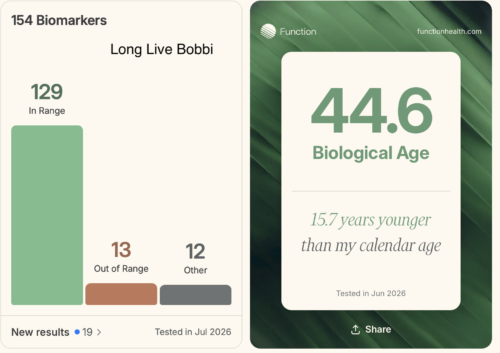 I had my labs done in July, my biological age is 15.7 years younger than I am, that makes me 44 biologically while I am 60 chronologically. I still can’t do what I did when I was 44 y/o. I’m aging healthy but still the body changes.
AGING IS A PRIVALEGE
Not everybody gets to do it.
And yes you can age healthy. Modern medicine wants to treat aging like its a disease. Everyone’s cholesterol rises as you age and everyone’s blood pressure increases as you age, Cleveland Clinic even says on their site “blood pressure rises with age”.
My TCM dr. tells me my pulse pressure is more important than blood pressure. Pulse pressure is the difference between your systolic and diastolic. If both numbers rise and fall in a tandem, it is most likely ok.
Blood pressure meds make you dizzy and more likely to fall, and they make you tired. There is also a risk of them taking your blood pressure too low while you sleep, which impairs blood flow to the eyes leading to eye diseases. How many people do you know on blood pressure meds also dealing with eye diseases as they age?
Statins won’t make one age healthy, they increase the risk for both diabetes and dementia. What good is low cholesterol if your brain is dysfunctional and/or you have high blood sugars? And furthermore people with low cholesterol don’t have any benefits when it comes to heart disease. The cholesterol number tied to the people who live the longest … 236! The markers set for healthy aging might be off!
I would like to add the body is intelligent; cholesterol is needed by the brain, perhaps cholesterol rises as one ages to protect the brain! And blood pressure increases because it needs to. Our arteries naturally stiffen as you age and your tissues need blood supply. It was pointed out by “A Midwestern Doctor” that when one is put on blood pressure meds, their body raises their blood pressure because it needs it. Then they get put on a second blood pressure med … and so it goes.
“Excessively lowering blood pressure cuts blood flow to parts of the body that can’t function without sufficient blood flow. For example, blood pressure medications increase the risk of kidney disease,12,13 and suddenly passing out (from insufficient blood flow to the brain) is one of the most common side effects of blood pressure medications.14,15”
Medications maybe be necessary for some, and if you feel the medication necessary for yourself, or less scared of an event then you should take the medication. In my experience medications only make one get sicker and sicker. Once you start on one, you end up taking more and more.
What does healthy aging look like? Not just an absence of disease though that is certainly part of it. Healthy aging is happiness, social connections, being able to easily get up and down from the floor, being able to do the activities and other endeavors you enjoy, not letting stress get the better of you, maybe being able to travel. Accepting your body as it ages is healthy aging.
And I know for me, my biggest struggle is the weight fluctuations that come with aging. And while I’m not at my ideal weight I’m trying to be ore accepting of it. I still just want lose another 5 lbs! its been easier for me to accept how my practice has changed over the years.
Accepting how your practice has changed over the past 10-20 years is progress in your yoga! Yoga is the process of refining the mind. Hopefully after all these years of yoga-ing we are getting better at that as well.
12 Cochrane Database of Systematic Reviews 2009, Issue 3. Art. No.: CD004349
13 Cochrane Database Syst Rev. 2020 Dec 17;12(12):CD004349
14 Journal of Hypertension 40(Suppl 1):p e5, June 2022
15 BMJ 2021; 372
Follow up
This spurred a big discussion on cholesterol, whether or not its a good metric to predict heart disease, and if not what other measures can we look at? I am influenced by Functional Medicine (I am a functional medicine certified health coach).
First of all, instead of looking a LDL cholesterol as the bad cholesterol you need to determine what kind of LDLs you have. Most are heart healthy and needed by the body. The problem is if they are oxidized and if their particle size is small and dense.
Oxidized LDL results from a poor inflammatory and high sugar diet, it has been tied to increased heart disease risk.
Most LDL are like fluffy beachballs bouncing off your artery walls. When LDL particle size is small, what they call VLDL or Very Low Density Lipoproteins they carry a higher risk for lodging in the arterial wall, and then if they become oxidized the problems begin. It has been theorized that trans fats promote the VLDL particles, and perhaps the oxidized vegetable oils as well.
And of course due our messed up health care system that cares more about profit than your health, they are not covered by insurance. You can order them through your doctor and they are not real pricey (at least through my.functionhealth.com —what I use).
These are the metrics that are being suggested as more important than cholesterol:
#1 Insulin Sensitivity
Most doctors check blood sugar and HbA1c but not insulin sensitivity. Insulin is what regulates your blood sugar levels. It regulates glucose uptake in muscle, liver, and fat and suppresses new glucose production from the liver.
Measuring fasting insulin levels can give an early picture of how well your body is controlling blood sugar, sometimes long before glucose levels become abnormal. When fasting insulin is high but blood sugar is still normal, it may be a sign of insulin resistance, meaning the body needs extra insulin to keep sugar in check.
This can go on for years before pre-diabetes or type 2 diabetes may show up in standard tests. Reduced insulin sensitivity is also a marker for increased risk of dementia and Alzheimers which are currently being called Type III diabetes diseases.
Optimal ranges for fasting insulin levels is generally considered to be below 5 µIU/mL.
Root causes of elevated fasting insulin include poor diet, chronic stress, sleep deprivation, obesity, and sedentary lifestyle.
Certain medications contribute as side effects including steroids, antipsychotics, beta-blockers, oral contraceptives, and sulfonylureas (a diabetes medication).
Also environmental toxin exposure has been linked to insulin resistance (most likely due to the stress it puts on the body) including air pollution, heavy metals, pesticides, and VOCs (Volatile Organic Compounds) like car exhaust.
As always whole, real food, cooked yourself and sourced local and organic as much as you can is your best defense. Including low glycemic foods, lots of fiber from foods, and adequate protein.
Spices to include that help regulate blood sugar are cinnamon, ginger, turmeric, and fenugreek.
Triglycerides
Triglycerides are a type of fat in our blood, and stored by the body for later energy use. The fat we all want less of! If you’re always storing and never using that energy because of too much food, too little movement, or insulin resistance, it starts to build up.
High triglycerides often develop when insulin resistance is present.
Triglyceride levels are very responsive to diet and lifestyle modifications. This can be motivating to track and lets you look past the standard cholesterol numbers and focus on how well your metabolism, blood sugar, and inflammatory systems are working together (or not).
Optimal ranges
- Women: 20-70 mg/dL
- Men: 30-70 mg/dL
This biomarker fluctuates!
Triglyceride levels can change based on what’s happening in your body and life at the moment. Factors like what you eat, how much you exercise, stress levels, blood sugar control, and even how much sleep can influence it.
All the same foods to keep insulin regulated keep triglycerides in check as well. In addition to not eating 3 hours before bed and trying to have a gap of 12 hours or more between your last meal of the day and breakfast.
ApoB – Apolipoprotein B The “new” kid on the block. And the one that will soon be replacing cholesterol levels.
While many think that low-density lipoprotein (LDL) cholesterol is the biggest risk factor for predicting heart disease, it is not. What is more important is the amount of apolipoprotein B (ApoB) particles which is tied to the amount of VLDL you have.
ApoB is a key protein involved in lipid metabolism. Measuring ApoB is important because it provides a direct count of what is believed to be the plaque-forming (atherogenic) particles.
High levels of ApoB correlate with more small, dense, and harmful LDL particles and are associated with an increased risk of atherosclerosis. https://www.ahajournals.org/doi/10.1161/jaha.122.025858
Elevated ApoB levels are also often observed in individuals with insulin resistance. Insulin resistance can lead to an increase in VLDL, subsequently raising ApoB levels. A vicious cycle.
Two people can have the same LDL level, but if one has more small, dense particles, their ApoB will be higher and their risk much greater. When there are many small VLDL particles (reflected by high ApoB), they compete to bind to LDL receptors and the LDLs aren’t cleared efficiently from the blood.
This leaves them circulating longer, where they are more likely to become oxidized. Once oxidized, they can no longer bind to receptors and are instead absorbed by white blood cells called macrophages, forming “foam cells” that trigger inflammation and build up soft plaque in artery walls. These vulnerable plaques can rupture, increasing the risk of heart attack or stroke.
Normal levels should be <90 mg/dL
Nutritionally, a Mediterranean-style diet rich in omega-3 fats, fiber, and antioxidants can help maintain lipid balance and reduce oxidative stress.
Botanicals like berberine and turmeric can be used to support insulin sensitivity and ApoB levels.
Lp(a) Lipoprotein(a)
Lp(a), is a type of cholesterol particle that is largely determined by your genes and inherited from your family. Lp(a) is made of a low-density lipoprotein (LDL) particle and carries an extra protein called apolipoprotein(a) that makes it stickier and more likely to contribute to plaque buildup in your arteries.
An elevated level of Lp(a) is an independent risk factor for major adverse cardiovascular events. Since Lp(a) typically remains stable throughout life, measure it once to establish your inherited cardiovascular risk. This is one where your “parental choice” matters.
Why check it if you can’t change it? Identifying elevated Lp(a) can change how aggressively you choose to approach prevention and adopt healthier lifestyle patters.
Optimal ranges:
Lp(a) below 50 nmol/L is optimal. Levels above 125 nmol/L are associated with a higher risk of cardiovascular diseases.
There are a few incidences that make this biomarker fluctuate
Temporary fluctuations may occur during acute illness, infection, inflammation, hormonal changes (menopause and hormone replacement therapy), tissue injury, or recent surgery. Certain medical conditions, particularly kidney disease or advanced liver disease, can also influence Lp(a) levels.
These changes do not mean that your underlying genetic baseline has changed, but rather reflect temporary changes in how the liver produces Lp(a), how the body clears it, or the body’s inflammatory response at the time of testing.
Dietary changes, body weight, and physical activity generally have little or inconsistent effects on Lp(a). In addition, laboratory testing methods can sometimes create small apparent differences in Lp(a) measurements.
For the most reliable assessment of Lp(a), it is best to measure levels when you are not having an acute medical issue.
hs-CRP High Sensitivity C Reactive Protein
And lastly always good to know where you inflammation levels are. These can fluctuate and are within your reach to change.
This measures your level of inflammation, and when it is consistently elevated you know you have systemic chronic inflammation. Acute inflammation is good, its your body coming to heal. Chronic inflammation is bad, it is your #1 marker for all kinds of diseases.
Ideally this should be <1.0 mg/L
Consistently elevated levels reflect lifestyle factors like poor diet, psychological stress, sleep hygiene, certain toxins, allergens, or imbalances in the gut microbiome.
It is important to note that persistently elevated hs-CRP level above 10 mg/L is generally considered a strong indicator of acute inflammation or infection, and further investigation is warranted to determine the underlying cause.
If you have a cold, an injury, poor sleep, are under emotional stress, or even exercised intensely the day before your blood draw, your hs-CRP may be temporarily elevated. Chronic conditions like autoimmune diseases or metabolic imbalances can cause an elevation over time. That’s why one single test isn’t always enough to tell the full story. It is best to look at trends over time and consider what was happening in your life when the blood draw happened, like whether you were sick, stressed, or inflamed in some other way.
This is a marker you want to check every time you do any blood draws.
Wrapping it up …
In regards to heart health; Movement and fiber is your friend!
In closing health care and medical care need to be NOT FOR PROFIT. The misinformation abound in the current medical paradigm are much a problem of profit. Doctors and Big Pharma don’t make money if you are well. Doctors are still not trained in using food and lifestyle as medicine, though I think we are getting closer to that changing.
I remain optimistic.
References: my.funtionhealth.com and they have a full list of their references under each biomarker.