
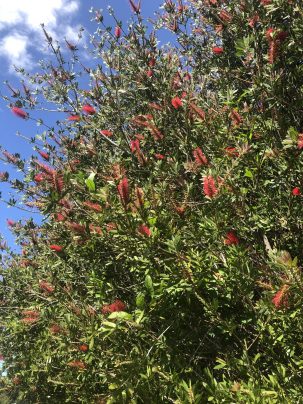
Photo by Bobbi Misiti
Instructions
The Red Bottlebrush bush is in the same family as Eucalyptus and Tea Tree (Myrtle family or Myrtaceae), this species smells like a lemony soft eucalyptus but it is a Tea tree.

Photo by Bobbi Misiti
Melaleuca citrinus aka Callistemon citrinus
Melaleuca citrinus also known as the crimson bottlebrush, has medicinal uses as an antimicrobial, antiseptic, and anti-inflammatory. Its essential oil is used for treating skin infections and promoting wound healing, making it valuable in traditional and modern medicine.
Radulović NS, et al. 2015. Aboriginal bush foods: A major phloroglucinol (polyphenol) from crimson bottlebrush flowers (callistemon citrinus, myrtaceae) displays strong antinociceptive and anti-inflammatory activity. Food Research International 77:280-9.
It is helpful for respiratory systems and clearing mucus from the lungs. As with all species in the Myrtle family; it has an affinity for the respiratory system, is highly anti-microbial and anti-viral, stimulating and cleansing.
Also like tea tree, red bottlebrush hydrsosol is also useful for helping to clear skin infections.
The medicinal properties found in the extract of the flower has been used in the development of a variety of anti-inflammatory, antioxidant, as well as cardioprotective drugs, noting too that some drugs have been effective at fighting off viral and parasitic infections. (Radulović et al. 2015) Crimson Bottlebrush, has chemical properties sequestered in the flower of the plant that have been used in the formulation of medicinal treatments as well as food and drink preparation.
Traditional benefits of Bottlebrush plant
- Used as diuretic and for relieving problems of the urinary tract.
- Flowers are edible
- Used by women as douche to cleanse the genitourinary tract from excessive menstruation or mucosal discharge as leukorrhea.
- Used for urinary incontinence and bed-wetting in children.
- In Jamaica, decoction of leaves used as “hot tea” treatment of gastroenteritis, diarrhea, and skin infections.
- Indigenous people of Australia used the bottle brush flowers as a natural energy drink.
- Bottle brush essential oil is used to harmonize a room or house bringing tranquil healing vibrations.
I distill the leaves and some of the red flowers to make the hydrosol, it has a very nice soft and sweet eucalyptus like scent. I use it in ultrasonic diffusers — without any essential oils, just put in the hydrosol like you would water.
I also like to use it to spray it on my body just prior to moisturizing.
2 oz bottle w/ spray cap $15.00
4 oz bottle with a screw cap $25.00
Contact Bobbi 717/443-1119 to order.
-

Red Bottlebrush Hydrosol
Price range: $15.00 through $25.00 Select options This product has multiple variants. The options may be chosen on the product page
Stella <3, my stainless steel little still 🙂

Photo by Bobbi Misiti

About Hydrosols: They are under appreciated currently! They have so much to offer. They have valuable therapeutic, cosmetic, and culinary properties. They are less known than essential oils yet they have been used for 3000-4000 years. Written records by Egyptians, Hippocrates, and others used them long before essential oils. In the past plants were distilled for their hydrosols not essential oils.
They are sometimes called hydrolats or floral waters —they are distilled.
The word “hydrosol” is derived from the Greek hydro, meaning water, and the Latin sol, meaning solution. When plants are distilled, an essential oil and a hydrosol are produced.
Hydrosols, are the water product of distillation. They carry the hydrophilic (water-soluble) components of the plant, as well as microscopic droplets of essential oils in suspension. Hydrosols have 1% or less of essential oils in them.
(Essential oils are also a product of distillation —essential oils require much more plant material. Essential oils are the lipophilic (fat soluble).)
Hydrosols have a wide range of uses, they are much safer than essential oils to use —they can even be used for children and babies —and they are safe for animals. How to employ:
- Are best used to help add moisture to your skin care routine by spritzing on your face and body prior to moisturizing.
- Are anti-inflammatory and also cooling, useful with aloe vera gel to cool pitta /inflamed conditions e.g. too much heat in the body causing outward representation on the skin.
- Are effective wound healing agents.
- Can be used as effective toners.
- Hydrosols can be mixed with clay to make a clay mask
- Hydrosols can be added to baths
- Are safe for internal use (try a teaspoon in a glass of water for a refreshing drink). If you are sensitive to acidic foods, citrus hydrosol are quite acidic and might not be your best option to enhance your water.
- Can be supportive to cooling or relaxing of the body/nervous system/mind (think aromatic spritzers). A true hydrosol is NOT water with essential oils in it, most spritzers are. The best spritzers are true hydrosols.
How to use hydrosols?
Most common:
#1 mist face and body prior to oil or moisturizer. This helps your oil to seal the moisture into your skin.
Water attracts water, when you just spray your face or even take a bath without moisturizing the water from the shower or spray will pull the water from your skin. However if you mist your face with water or hydrosol, then immediately apply moisturizer or oil the water in your skin will pull the water on the surface inward to deeper layers of your skin providing better moisture in your skin.
- Need to uplift your mood? Use grapefruit hydrosol or any citrus hydrosol.
- Want to brighten your skin or balance your hormones? Use rose geranium or tangerine hydrosol.
- Working on a big project, school, or learning and remembering something? use rosemary hydrosol.
- Feeling a little congested? Try the red bottlebrush (eucalyptus) hydrosol.
- Have a little cut or scrape? Use yarrow hydrosol
- Need an astringent hydrosol to clear oil and/or pores? Try Lemon.
- Need a powerful anti-bacterial? Use Niaouli (tea tree family) hydrosol.
Use as a toner, pour a little on an organic cotton pad or ball. Or blend 2 different hydrosols and add a little aloe vera or witch hazel hydrosol and make a toner. I offer these here.
In your hair! Mist your hair and fluff it with your fingers, hydrosols help to keep your hair clean and fresh. Rosemary is particularly good for your hair, helping it to grow in thicker. Rose Geranium or Grapefruit hydrosols are nice because they are a little astringent and will help to remove oil or dirt from your hair.
Add 1 tsp to a cup of water and enjoy.
Air spritzer – works great in the bathroom
I gargle with hydrosols! My favorite to gargle with is rose geranium.
Eye Pads – soak a cotton pad in hydrosol and lay one on each eye — this is nice when the hydrosol is chilled.
Feeling a little hot flash? Spritz your face with a hydrosol.
Medicinal:
Eye infections, of any type that I’ve experienced have been nipped in the bud many times by me spraying one of my hydrosols on at the first sign of any symptoms.
Poison Ivy – I have found hydrosol helpful at receiving itch from poison ivy — specifically rose, chamomile, and peppermint, used singly.
Spray on a cut or wound to aid in healing and cleaning. Yarrow is especially good at this, it is a wound healer.
Use as a gargle or mouthwash, you can spray the back of your throat with any hydrosol then gargle with the same hydrosol. They can also be used for mouth affections such as canker sores. I like to use my red bottlebrush or niaouli hydrosols for sore throats.
Compresses – after you heat the water and wet your cloth, wring it out, then add a few spritzes of hydrosol.
Other:
Use in your clay mask recipe to make the clay paste – and you can use hydrosols after applying the mask —spritz your face with a hydrosol to keep your mask from drying out too quickly.
Add up to 1 tsp to your neti pot water
Use 1 cup in a foot bath and hand bath.
Add 1-2 cups to your bath (not very practical for most, but if you happen to have an abundance of a certain hydrosol).
In the laundry you can dampen a washcloth with hydrosol and put in dryer to help freshen stale or stinky clothing.
In the Kitchen
Add them to herbal teas or water — add 1 tsp in a cup of water up to 3x per day. This can be helpful to prevent catching something while traveling, or if you do have a cold it can help boost your immune system.
They can improve digestion when taken in water 10-20 minutes prior to eating or after eating to support detoxification.
Lemongrass hydrosol is good in soups, especially Thai lemongrass soups.
Freeze it in ice cube trays and use in iced tea.
You can even cook with them, they can add nice flavor when some of the water for rice is substituted with hydrosol. For best results add toward the end of cooking to preserve their benefits and aromas. You an also spray them on a hot dish just before serving.
Try soaking nuts in a tasty hydrosol like rose geranium or orange.
For Animals
Would cleansing
Fur rinsing in cases of inflammation, dermatitis, parasites and more.
Spray their coats with lavender or rose while brushing them —or to help repel insets or ticks.
As a compress for sore joints
Restlessness, stress, or fear —orange, tangerine, marjoram, lavender, or any floral hydrosol.
How to store:
Hydrosols can be kept for up to 3 years if stored in a cool, clean place, They are best kept refrigerated.
They can be frozen to preserve them longer.
They are best stored in glass containers.