
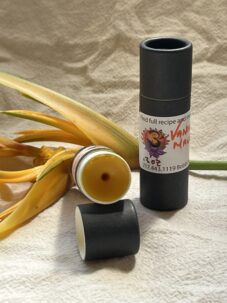
Photo by Patrick McDowell
Instructions
Vanilla Sandalwood Mango Lip Balm
ALL Ingredients are sustainably wild harvested, cultivated certified organic, biodynamic, or grown without chemicals
Ingredients: Vanilla infused jojoba, mango butter, cocoa butter, Maui beeswax, castor oil, sea buckthorn oil, and vitamin E oil.
Instructions: Manually push bottom of tube up with your finger. When you first use it, it will be a little harder to push up. After that is pushes up easily.
.3 oz in a Kraft paper lipstick tube $10.00

Hand poured in small batches.
This lip balm is a little firmer than my Bleu chamomile lip balm, it that softens up nicely when you rub it on your lips.
I included sea buckthorn for its UV protection, healing powers, beta carotene, and it also adds color. I added castor oil for its thickness, shine, and anti-inflammatory and cholesterol properties. Cholesterol helps the skin hold onto moisture.
I used coconut oil for palmitic acid which is lubricating, and jojoba (and coconut) for its tribehenic acid which is emollient and has humectant properties. Mango butter for its glycolipids which act as a skin conditioner.
I added sandalwood as its one of the only essential oils that is not drying, and it has cicatrisant (healing) properties and a calming meditative and loving scent
Why does my lip balm have white dots on it? It’s called blooming.
Do not worry – the lip balm is good to use and still makes your lips feel good and moisturized.
Since our lip balms are made with natural unrefined cocoa, shea, and mango butters, sometimes you can see that your lip balm has white spots on it. This is called “blooming”. It is not uncommon for products that are made with high percentage of natural butters to appears grainy. This is not a reflection on the quality of the butter, but rather a reaction to changing temperature the lip balm is exposed to.
There are various fatty acids within body butters. These fatty acids melt and cool at different rates and temperature leading to graininess, in finished goods or fresh butter, this process is also known as crystallization. Crystallization may take place right away, or it may only show up several months after the product has been manufactured – particularly if the product was exposed to temperature changes while being used, stored or transported. If the the process of cooling down is too slow, the fatty acids may crystallize into clumps or look grainy.
When I make lip balms I temper them quickly (cool them in the freezer) so the fatty acids cool down fast which will prevent grains from forming and the lip balms will be smooth. However during shipping or the temperature of the where they are stored between your uses the butters will melt and slowly re-solidify.
I only utilize clean ingredients that are beneficial to you, and avoid using ingredients that are unnecessary or problematic. Due to the absence of any chemicals, emulsifiers, or stabilizers in our lip balms, it is rather sensitive to the effects of heat. When lip balms are left in handbags or anywhere that are warm, it may melt and re-solidify into a gritty consistency after it has cooled. This is the outcome of melting cocoa, shea, or mango butter at a low temperature and letting it cool at a slow rate, which causes it to crystallize. Since the butter has larger molecules than coconut oil, it melts and solidifies at a different rate than coconut oil does. This is one reason why many lip balms products on the market typically contain additional synthetic chemicals to stabilize the products —and ours do NOT.
Grainy lip balms are super moisturizing and pose no health risk, and they dissolve when coming into touch with the skin. Don’t worry if this happens to your lip balm; it’s still good to use! Lip balm with a grainy texture is still effective.